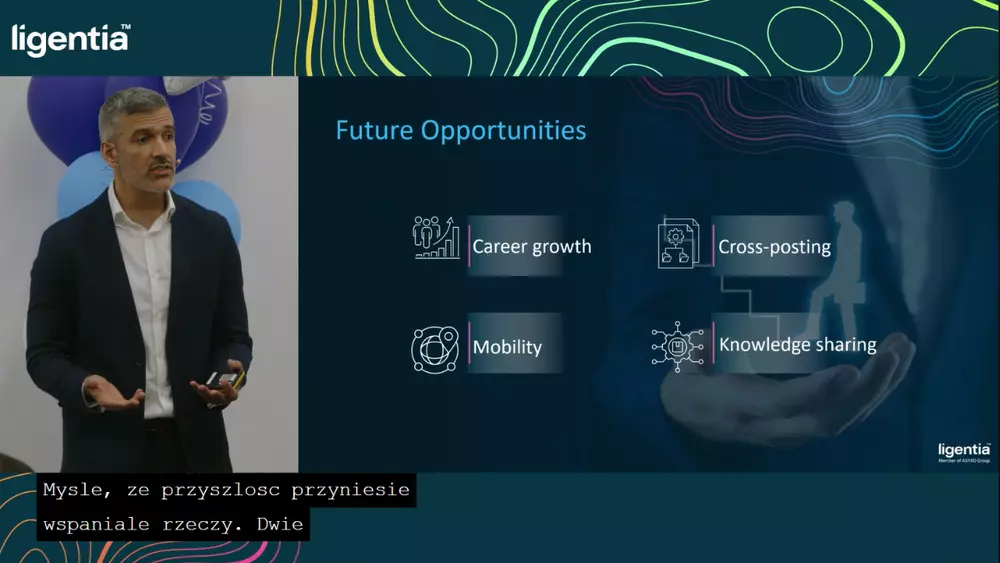
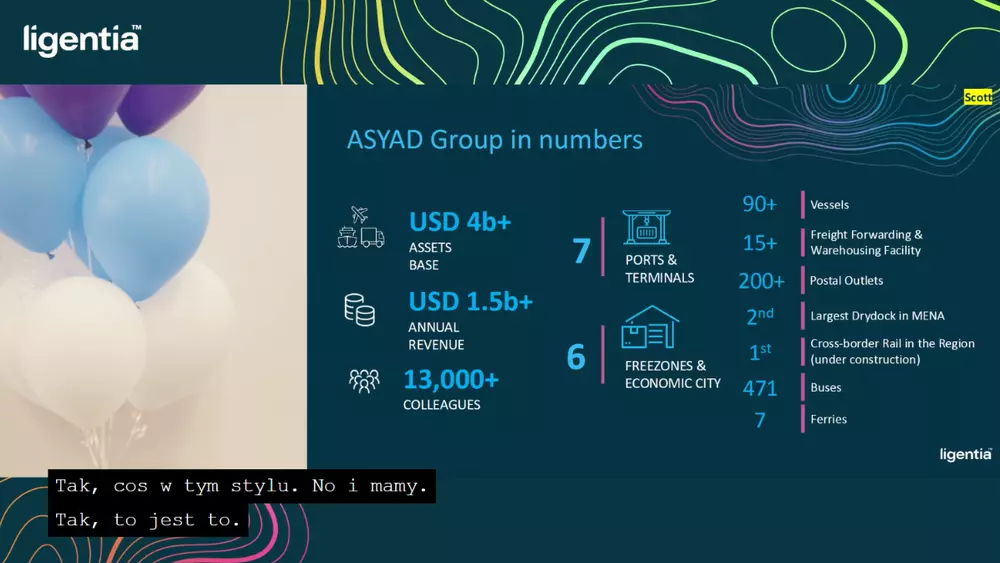
When Ligentia Group needed to share an important company announcement with employees around the world, the event had to work just as effectively for those joining online as those attending in person.
Stream7 provided the hybrid event and live streaming production from Nexus Leeds, creating a professional broadcast that reached employees across more than 20 countries - complete with live Polish translation using AI-generated subtitles.
The event formed part of Ligentia Group’s internal communications around the announcement of a company merger.
Taking place at Nexus Leeds on 23 April 2026, the event welcomed an in-person audience while simultaneously broadcasting to employees joining remotely around the world.
The aim was to create one joined-up experience, ensuring remote viewers could follow the announcement clearly and receive the same high-quality communication as those in the room.
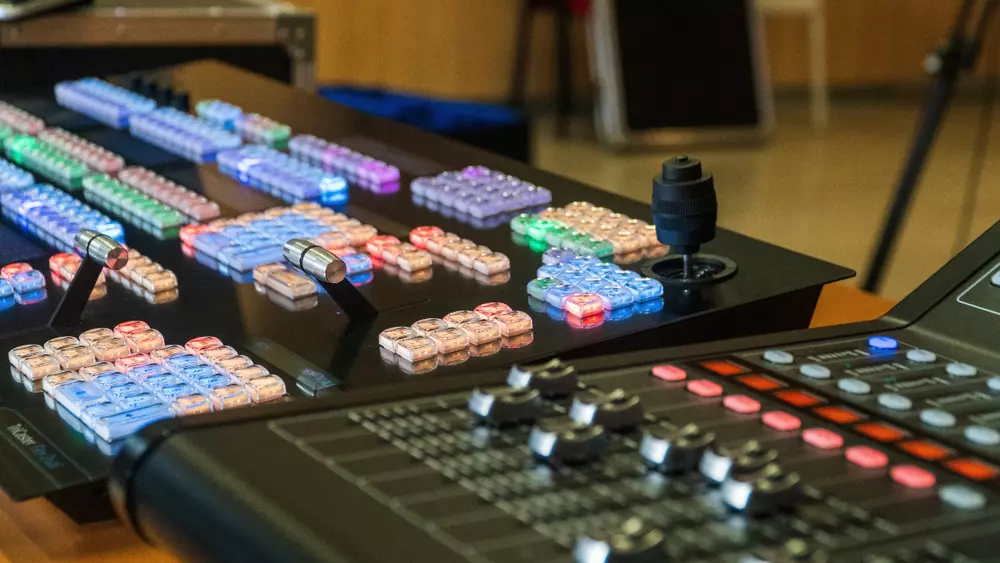
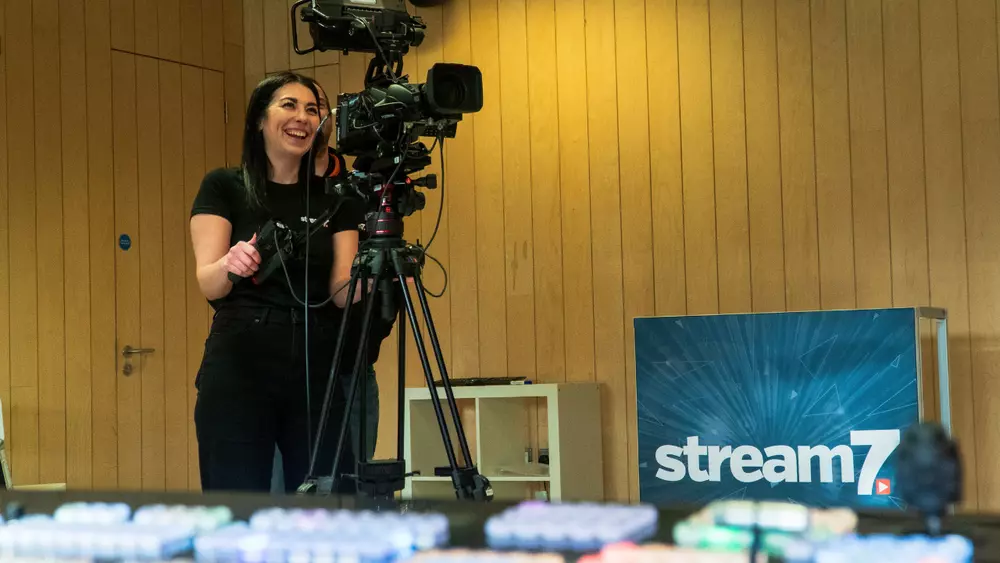
Our team provided the technical production required to turn the live presentation into a polished online broadcast.
Using our TriCaster production system alongside professional cameras and microphones, we captured the speakers and managed the live programme before streaming it directly to a custom microsite.
This gave Ligentia a dedicated online destination for the event rather than relying on a standard video conferencing platform, helping create a more professional and controlled experience for its global audience.
One of the most interesting elements of this project was the requirement to make the broadcast accessible to Ligentia’s Polish-speaking audience.
We integrated live AI-generated translation subtitles into the stream, translating the spoken English content into Polish as the event happened.
For international events, translation has traditionally added another significant layer of production. Depending on the event, this can involve interpreters, additional audio feeds, booths and supporting equipment, as well as the logistical challenge of coordinating everything alongside the main production.
AI-powered translation is beginning to change that.
For the right event, live AI subtitles can provide a much more cost-effective and scalable way of making content accessible in multiple languages. The technology has developed rapidly and can now provide reliable live translation with minimal delay, making it a practical option rather than simply an experimental feature.
It won’t replace every form of human interpretation, particularly where highly technical language, nuance or sensitive subject matter is involved. But for many corporate events, company updates, presentations and internal communications, it offers event organisers another increasingly capable option.
As businesses become more international and hybrid working continues to connect employees across different countries, event organisers increasingly need to think beyond simply providing a video stream.
The question is becoming: can everyone joining actually access and understand the content?
AI translation has the potential to remove some of the traditional barriers to multilingual events. Instead of creating entirely separate broadcasts or significantly expanding the production infrastructure, translated subtitles can be incorporated into an existing streaming workflow.
For event organisers, that can mean:
Lower translation and production costs compared with some traditional interpretation setups
Fewer additional technical requirements on-site
The ability to make broadcasts accessible to international audiences
A solution that can scale as audiences become more geographically diverse
Live translated content without requiring separate versions of the event
As the technology continues to improve, we expect live translation and captioning to become an increasingly normal part of corporate streaming - particularly for organisations communicating regularly with teams across different countries.
The Ligentia event provided a great example of how this technology can already be used in a real-world live production.
The broadcast attracted 1,447 plays, with viewers joining from more than 20 countries.
The largest audiences included:
Poland - 566 plays
United Kingdom - 212 plays
China - 146 plays
Oman - 116 plays
India - 102 plays
United Arab Emirates - 98 plays
Australia - 59 plays
Saudi Arabia - 35 plays
Hong Kong - 29 plays
Additional viewers joined from the United States, Germany, Belgium, the Netherlands, Japan, Canada, Singapore, Vietnam and several other countries.
With Poland accounting for 566 plays - by far the largest individual audience - providing Polish translation wasn’t simply an added feature. It played an important role in making the announcement accessible to a significant proportion of the people watching online.
For an announcement of this importance, the technology needed to support the message without becoming a distraction.
Our team managed the production throughout the event, bringing together the cameras, microphones, live vision mixing, streaming platform and AI translation technology within one workflow.
The result was a smooth, professional hybrid event that worked for both audiences. Ligentia was particularly impressed with how slickly the event ran and the quality of the final broadcast.
The production included:
TriCaster live production system
Professional camera setup
Microphones and audio capture
Custom event streaming microsite
Live broadcast production
AI-generated Polish translation subtitles
By combining established broadcast technology with newer AI-powered tools, we were able to provide a solution that met the needs of a genuinely international audience without unnecessarily complicating the production.
For us, projects like this demonstrate where hybrid event production is heading.
A professional livestream is no longer simply about putting a camera in a room and making the pictures available online. Event technology can increasingly help organisations overcome challenges around geography, language and accessibility too.
AI-powered translation is a particularly exciting part of that development. Used in the right circumstances, it can make multilingual broadcasting considerably more achievable for organisations that may previously have considered live translation too complicated or costly.
It also gives event organisers more flexibility. Translation doesn’t necessarily have to mean building a much larger production - it can increasingly become another integrated part of the broadcast workflow.
For Ligentia Group, that meant one live event in Leeds could reach employees across multiple continents, while providing Polish-speaking viewers with translated content as the announcement happened.
For organisations planning international town halls, company announcements, conferences or internal communications, that’s a significant opportunity - and one we expect to see much more of over the coming years.