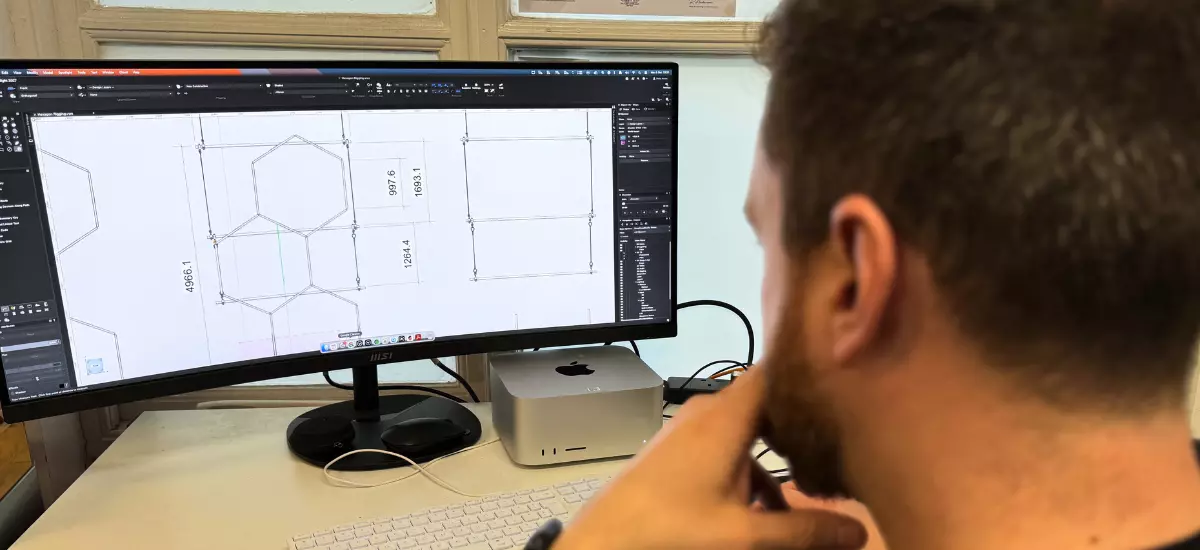
Why CAD Design Matters in Event Production
When you walk into an event and see a stage, screens, lighting and set all working together, it can be easy to think the transformation happened during the build.
In reality, some of the most important work happens weeks before the first piece of equipment arrives at the venue.
For larger or more complex productions, CAD design and visualisation play an important role in our event production planning process. They allow our team to take an initial idea and turn it into a detailed plan - helping both us and our clients understand exactly how the event could look and work before we start building it.
And, importantly, they give us the opportunity to change things while they're still easy to change.
What is CAD design for events?
CAD stands for Computer-Aided Design. Within event production, we can use CAD software to create detailed plans and visualisations of an event space before the event takes place.
Depending on the project, this could include the positioning and dimensions of:
- Staging and set
- LED walls and screens
- Truss structures
- Lighting
- Speakers and AV equipment
- Branded elements and backdrops
- Audience areas
- Cameras and production equipment
Rather than relying on a rough sketch or trying to explain a concept over email, CAD gives everyone involved a much clearer picture of what we're proposing.
It turns "we're thinking of putting a screen here" into something the client can actually see.
Giving clients confidence before the build
One of the biggest benefits of producing event designs in advance is that our clients aren't waiting until the event setup to discover what their space is going to look like.
We work closely with clients throughout the planning process, discussing what they want to achieve and developing the technical design around their event, venue, audience, branding and budget.
Once we've produced an initial design, we can share it with the client and gather feedback. Perhaps they'd like the screens positioned differently. Maybe a branded element needs to be more prominent. The stage could feel too large, or there may be an opportunity to use the available space more effectively.
Those conversations are much easier to have during the design stage than when a crew is already on site building the event.
The aim is simple: by the time we arrive for the setup, everyone should know what we're building and be happy with the plan.
Finding problems before they become on-site problems
CAD isn't just about making an event look good. It's also an important technical planning tool.
Event venues come with all sorts of practical considerations, from ceiling heights and room dimensions to access routes, audience sightlines and the amount of space available behind a stage.
Planning these elements in advance allows our production team to identify potential challenges much earlier.
Will the proposed screen fit comfortably into the space? Will guests at the back of the room have a clear view? Is there enough room for the required staging and technical equipment? How will the different production elements fit together?
Resolving questions like these during pre-production can make the eventual setup much more efficient. It also means we're not turning up with equipment simply because "that's what we normally use". The production can be designed specifically around that particular event.
From CAD to reality: Accu Presents FightFest
A great example is our event production for Accu Presents FightFest at Smart Manufacturing Week 2026.
This wasn't a conventional exhibition stand. Accu created a fully operational robot fighting arena, with Stream7 responsible for the technical production surrounding it. The finished experience incorporated multi-camera production, large-format LED displays, live graphics, digital signage, professional lighting, sound and production infrastructure.
With so many different technical elements sharing the same exhibition space, detailed planning was essential.
Everything needed to work together - not just technically, but visually too. Screens needed to provide visibility for the crowds gathering around the arena, cameras needed useful positions to capture the action, and lighting, sound and graphics all needed to contribute to the overall experience.
Planning the production ahead of the event gave the team a clear blueprint to work from when it came to installation.
The result was an exhibition space that operated more like a live entertainment venue, attracting large crowds throughout the two-day event.
Designing the Rowan Campbell-Pilling GB3 car launch
CAD also played an important role in our production for the Rowan Campbell-Pilling GB3 car launch at Magna.
For this event, the design itself was a major part of the brief. The new GB3 car was the centrepiece of the evening, so we needed to create a stage environment that would frame the reveal while also working for presentations, performances and other parts of the event.
Our team developed a full stage and set design using CAD visualisation, allowing us and the client to see how the proposed layout would work within the venue before installation began. We could consider sightlines, screen placement, lighting positions and the overall scale of the production in advance.
The final design incorporated staging, truss structures, a custom branded backdrop and two integrated 75-inch screens.
Because the design had already been developed and agreed, the technical team arrived on site with a clear plan for turning that visualisation into the finished event.
Making better use of your event budget
Detailed design can also help clients understand where their event AV budget is going.
There are usually several ways to approach an event production brief. A larger LED wall might look fantastic, for example, but is it the best use of the available budget? Would a different screen configuration achieve the same objective? Could changing the stage layout improve the audience experience without adding more equipment?
Being able to visualise different approaches makes those conversations much more useful.
Instead of choosing equipment in isolation, we can look at the production as a whole and decide where investment will make the biggest difference.
A smoother setup on site
Event setup days can be busy. There are often multiple suppliers working simultaneously, venue access windows to contend with and a fixed deadline when everything needs to be ready.
The more decisions that can be made beforehand, the better.
A well-planned CAD design gives the production crew a clear reference for the build. Everyone knows where key elements need to go, how the different parts of the production fit together and what the finished result should look like.
There will always be occasions when something needs adjusting on site - that's the nature of live events - but good pre-production significantly reduces the number of decisions that need to be made under pressure.
Collaboration is a big part of the process
CAD isn't about us disappearing, designing an event and presenting the client with a finished plan.
It's collaborative.
Our job is to combine the client's ideas and objectives with our technical knowledge and experience. We can advise on what will work within the venue, suggest alternatives and help develop ideas into something that's practical to deliver.
That might mean several conversations and revisions before the final design is agreed - and that's exactly what the planning stage is for.
We'd much rather move something around on a CAD design than discover during the build that the client had pictured something completely different.
Good event production starts long before event day
The setup might be the point where everything becomes visible, but successful event production starts much earlier.
From initial conversations and site information through to CAD designs, technical planning and client sign-off, good pre-production gives everyone involved a clearer understanding of what we're working towards.
It helps us spot challenges earlier, plan equipment more effectively, make better use of budgets and, most importantly, make sure our clients are happy with what we're creating before we arrive on site.
At Stream7, our event production services cover the whole process, from the initial idea and technical design through to installation and delivery on the day.
Planning an event and want to see how your ideas could work in the space? Get in touch with the Stream7 team and let's start designing it.