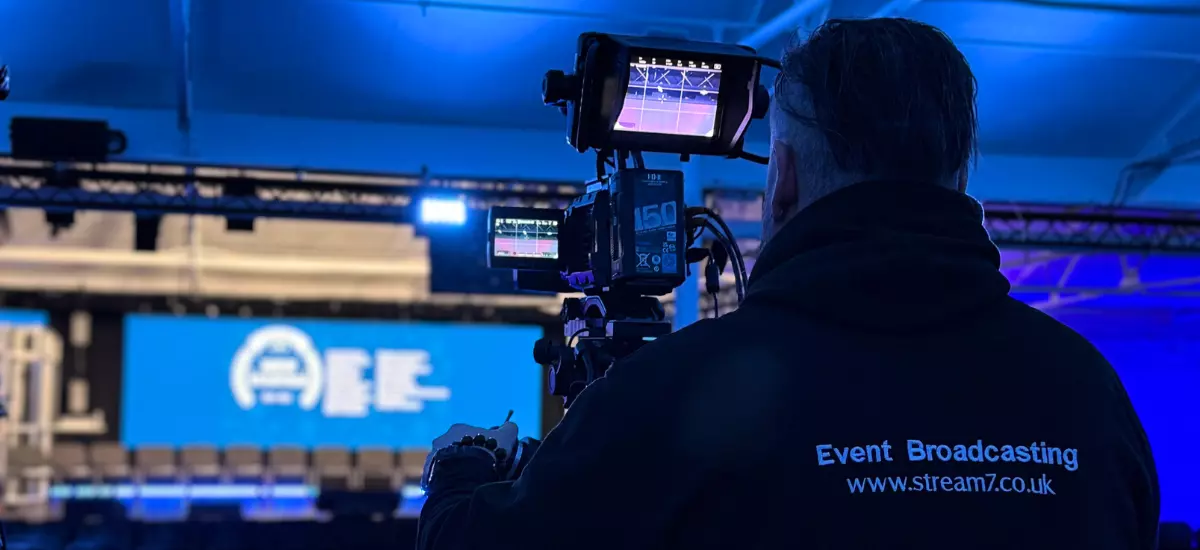
Hybrid events are now a normal part of conferences, internal communications, training sessions and awards ceremonies.
And yet, a huge number of them still feel awkward, unreliable and strangely disappointing for anyone watching online.
From the outside, hybrid events look deceptively simple. Put a laptop at the back of the room, open Teams or Zoom, press record, and job done.
Technically, that is a hybrid event.
In reality, it is usually a waste of time for your online audience and a missed opportunity for your organisation.
This is the pattern we see again and again. Well-intentioned events that technically happen, but fail to engage, fail to inspire confidence and fail to deliver a good experience for anyone not physically in the room.
So what actually works in a hybrid event, and what is just noise, habit or false economy?
Let us start by clearing up a few of the biggest myths.
Myth one: Teams or Zoom on a laptop is basically a hybrid event
This is by far the most common assumption, and the one that causes the most problems.
Teams and Zoom are excellent tools for meetings. They were never designed to be broadcast platforms for conferences, town halls or large-scale events. A single laptop camera at the back of a room cannot capture speakers properly, cannot follow audience interaction, and cannot deliver a professional viewing experience.
The result is usually poor audio, awkward camera angles, tiny speakers in frame and slides that are unreadable for online viewers. It sends an unspoken message to remote audiences that they are an afterthought.
What actually works
Treating the online audience as a primary audience, not a secondary one. That means multiple cameras, proper audio capture, vision mixing and a deliberate run of show designed for people watching remotely.
Myth two: Hybrid just means putting a camera at the back of the room
This is closely linked to the first myth and just as damaging.
Hybrid is not a camera. Hybrid is a format. It is the intentional design of an experience that works for two very different audiences at the same time.
In-room audiences can see body language, feel atmosphere and follow natural movement on stage. Online audiences rely entirely on what you show and what they hear. If the camera framing is wrong, the audio is muddy or slides are badly captured, their experience collapses instantly.
What actually works
Camera coverage, audio quality, graphics, slide integration and pacing. Directing the viewer’s attention, just like a TV broadcast.
Myth three: Venue Wi-Fi is always good enough for streaming
It almost never is.
Venue Wi-Fi is designed for guests checking emails and scrolling social media, not for pushing a live video signal to hundreds or thousands of viewers without interruption.
We have seen streams drop mid-keynote, audio desynchronise, and entire sessions disappear because someone trusted the venue connection without a backup.
What actually works
Planning connectivity as a production priority. Bonded internet, dedicated hard lines and mobile backup connections. Planning for failure is not pessimistic. It is professional.
Myth four: Rehearsals are optional
This one usually comes from time pressure or budget pressure, and it almost always backfires.
Hybrid events are more complex than in-room events because they combine live production, streaming technology, content playback and audience interaction across platforms.
Without a rehearsal, you are testing everything live in front of your audience. Slide handovers go wrong. Speakers forget where to stand. Audio levels fluctuate. Videos fail to play. Streaming links do not work.
What actually works
A short technical rehearsal and a basic run-through of the show flow. These eliminate most problems before the audience ever sees them.
Myth five: Online audiences do not need engagement or production value
Online audiences are less forgiving than in-room audiences, not more.
They are one click away from leaving. They are watching on smaller screens, often while multitasking. If the sound is poor, the visuals are boring or the pacing drags, they disengage instantly.
Production value is not about making things flashy. It is about clarity, energy and storytelling.
What actually works
Good audio. Clear visuals. Thoughtful camera changes. Branded graphics. A well-structured run of show. These are not luxuries. They are the foundations of a watchable online experience.
Myth six: Cutting production saves money overall
It usually costs more in the long run.
When production is under-scoped, the consequences show up elsewhere. Low attendance for future events. Negative internal feedback. Poor sponsor value. Damaged brand perception.
We regularly see organisations spend significant budgets on venues, catering and staging, then compromise the one part that determines how the majority of their audience experiences the event.
What actually works
A well-planned hybrid production that is intentional, not excessive. Hybrid does not have to be expensive, but it does have to be designed properly.
Myth seven: Accessibility is expensive and only needed for big public events
Accessibility is not just about compliance. It is about inclusion and reach.
Captions, good audio quality, clear camera framing and platform accessibility features make events better for everyone, not just people with declared access needs.
What actually works
Designing accessibility in from the start. It is far easier and cheaper than trying to bolt it on at the end.
Myth eight: Hybrid events are a temporary trend
Hybrid is not going away.
It is now an expected option for conferences, internal communications, training and stakeholder events. Audiences expect flexibility. Organisations expect reach. Sustainability policies increasingly favour reduced travel.
What actually works
Treating hybrid as a permanent format and investing in doing it properly. What will disappear are badly executed hybrid events.
So what really works in a hybrid event?
It is not the platform.
It is not the camera model.
It is not the latest piece of event tech.
What really works is audience experience, reliability and planning.
That means prioritising audio quality above almost everything else. Designing camera coverage that makes speakers and content easy to follow. Planning connectivity with proper redundancy. Building a clear run of show. Rehearsing. Thinking about accessibility. Having someone whose job it is to think about what happens when something goes wrong.
Most hybrid event problems are not technical. They are planning problems.
What is mostly a waste of time?
Relying on venue Wi-Fi.
Treating Teams like a broadcast platform.
Skipping rehearsals.
Under-investing in audio.
Designing only for the in-room audience.
Adding flashy tech without fixing the fundamentals.
These choices feel cheaper and quicker in the short term. They almost always cost more in the long term.
Hybrid does not have to be complicated or expensive
This is the part that surprises most clients.
When hybrid is designed properly from the start, it becomes simpler, not more complex. Decisions become clearer. Budgets become easier to justify. Production becomes more predictable.
The chaos happens when hybrid is treated as an afterthought.
At Stream7, we see our role as a production partner, not just a supplier. Our job is to design hybrid events that work for both audiences, plan for failure before it happens, and deliver something that feels calm, professional and watchable.
Because the goal is not just to run a hybrid event.
It is to run one that people actually want to watch.