When you're planning an event, one of the first - and most important - decisions you'll make is what type of event to hold. The format you choose influences everything from your budget and venue requirements to audience engagement, sustainability and the overall success of the event.
With so many options now available, from traditional conferences and exhibitions to virtual events, hybrid experiences and live streamed productions, it can be difficult to know which approach is best. While every event has different objectives, there is no one-size-fits-all solution. The right format depends on what you're trying to achieve, who your audience is, where they're located and how you want them to interact with your content.
In this guide, we'll explain the most common event types, discuss where each one works best, compare the advantages and disadvantages, and explore how budget and sustainability can influence your decision.
Why your event format matters
Many people focus on the venue or the speakers first, but the format should really come before either of those decisions. Choosing the right event type provides a framework for every other aspect of planning.
For example, a product launch designed to generate excitement and networking opportunities may benefit from being held in person, while a global staff briefing would almost certainly achieve greater reach and better value as a virtual or hybrid event.
Your chosen format will affect:
- Your overall budget
- The technology you'll need
- Delegate attendance
- Speaker availability
- Networking opportunities
- Accessibility
- Environmental impact
- How much content you can reuse afterwards
It's worth taking time at the planning stage to think beyond simply getting people in a room. Many organisations are now asking how they can maximise attendance, improve accessibility and create content that continues to provide value long after the event has finished.
In-person events
Traditional face-to-face events remain the most popular format for many organisations, particularly where networking and relationship building are key objectives.
Whether you're hosting an annual conference, an awards ceremony, a product launch or an exhibition, bringing people together in the same room creates an atmosphere that's difficult to replicate online. Conversations happen naturally during coffee breaks, delegates make valuable business connections and speakers often receive immediate feedback from the audience.
However, in-person events also require the greatest level of logistical planning and usually represent the largest investment.
Common examples of in-person events
- Conferences
- Exhibitions
- Awards ceremonies
- Networking events
- Roadshows
- Product launches
- Annual meetings
Advantages of in-person events
- Excellent networking opportunities
- Strong audience engagement
- Creates memorable experiences
- Easier relationship building
- Ideal for hands-on demonstrations
- Better sponsor visibility
Things to consider
- Higher venue costs
- Delegate travel expenses
- Accommodation requirements
- Catering costs
- Greater logistical planning
- Attendance is limited by venue capacity
Budget considerations for in-person events
In-person events generally require the largest budget because you're paying for much more than just the venue. Catering, furniture, staging, lighting, audio, registration systems, staffing and printed materials can all contribute to the overall cost.
Travel and accommodation may also need to be covered for speakers, staff or delegates. If an event runs over several days, these costs can quickly become a significant part of the budget.
While the overall investment can be substantial, many organisations consider it worthwhile because of the quality of face-to-face interaction and the networking opportunities an in-person event can create.
Sustainability of in-person events
From a sustainability perspective, in-person events usually have the largest carbon footprint. Delegate travel, hotel stays, catering and temporary event infrastructure all contribute to their environmental impact.
That doesn't mean an in-person event cannot be delivered more sustainably. Organisers can reduce its impact by selecting an accessible venue, encouraging public transport, reducing printed materials, working with local suppliers and choosing reusable staging and signage.
Careful catering choices can also make a difference. Accurate delegate numbers, locally sourced food and clear plans for surplus meals can help reduce unnecessary waste.
Virtual events
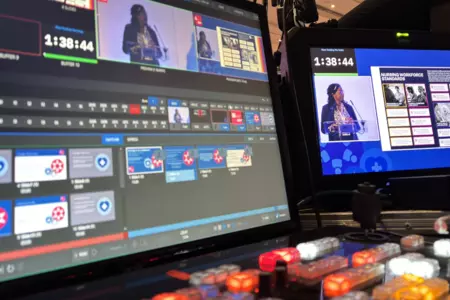
Virtual events have become far more sophisticated than simple video calls. Professionally produced online events can include multiple cameras, broadcast-quality graphics, interactive polling, moderated question and answer sessions, presentations and remote speakers joining from around the world.
For organisations with geographically dispersed audiences, virtual events can dramatically increase attendance while reducing many of the costs associated with physical events.
Unlike in-person events, delegates can join from almost anywhere with a reliable internet connection. This makes virtual events particularly useful for international organisations, training programmes, internal communications and events where accessibility is a priority.
Common examples of virtual events
- Online conferences
- Annual general meetings
- Staff briefings
- Investor updates
- Training sessions
- Educational events
- Product demonstrations
Advantages of virtual events
- Lower venue and catering costs
- No delegate travel
- Global audience reach
- Improved accessibility
- Sessions can be recorded easily
- Detailed viewing and attendance analytics
- Greater flexibility for speakers
Things to consider
- Reduced informal networking
- Potential screen fatigue
- Internet reliability
- Managing different time zones
- The need for engaging content and strong production
Budget considerations for virtual events
Although virtual events eliminate venue hire, catering and many travel costs, they shouldn't automatically be viewed as a cheap alternative. A professionally delivered virtual event still requires the right equipment, technical expertise and planning.
Depending on the scale of the event, the production may include cameras, microphones, lighting, presentation management, graphics, streaming software, audience interaction tools and a dedicated technical team.
The key difference is that more of the budget is invested in the digital audience experience rather than physical logistics. A well-produced virtual event can feel polished and engaging, while a poorly planned one may struggle to hold viewers' attention.
Sustainability of virtual events
Virtual events are generally the most environmentally friendly option because they remove the need for most delegate and speaker travel. They also reduce venue energy use, accommodation, printed materials and catering waste.
For organisations with environmental, social and governance targets, virtual delivery can be a practical way to reduce the carbon footprint of company-wide meetings, training sessions and international events.
Hybrid events
Hybrid events combine a physical venue and in-person audience with an online audience joining remotely. Rather than asking everyone to attend in the same way, hybrid events provide a choice.
Delegates who value face-to-face networking can attend the venue, while those who are unable to travel can still watch, contribute and participate online. This can increase overall attendance and improve accessibility without removing the benefits of an in-person experience.
A successful hybrid event should not treat the online audience as an afterthought. Both audiences need to feel included, with clear ways to watch, ask questions and engage with speakers.
Common examples of hybrid events
- Conferences
- Medical events
- Corporate town halls
- Leadership updates
- Product launches
- Educational conferences
- Membership events
Advantages of hybrid events
- Maximum potential audience reach
- Greater accessibility
- Flexible attendance options
- Better return on event content
- Sessions can be recorded
- Easier international participation
- Additional sponsorship opportunities
Things to consider
- More technical planning is required
- Experienced production support is important
- Two audiences need to be engaged simultaneously
- Production costs may be higher
- Online and in-room content must be coordinated carefully
Budget considerations for hybrid events
Hybrid events often require a higher production budget because you're effectively delivering two connected experiences at once. Alongside the in-room audio visual requirements, you also need cameras, streaming technology, online platforms and technical support for remote participants.
However, the additional cost should be considered alongside the potential value. A hybrid event can attract a much larger audience than the venue could accommodate on its own. It can also reduce travel costs for delegates and make it easier to involve speakers from different locations.
Recordings can then be edited and reused after the event, helping to extend the lifespan of the original investment.
Sustainability of hybrid events
Hybrid delivery offers a useful balance between face-to-face interaction and environmental responsibility. People who gain the most value from attending in person can still travel to the venue, while others join online.
This can reduce the number of flights, hotel stays and long-distance journeys associated with an event, without removing the networking and atmosphere of a physical gathering completely.
Live streamed events
Live streaming allows an in-person event to be broadcast to viewers elsewhere, extending its reach beyond the room. It can be used for a full event or for selected sessions, presentations or announcements.
Unlike a fully interactive hybrid event, live streamed viewers may take a more observational role. They watch the event as it happens but may have fewer opportunities to participate directly.
This makes live streaming particularly suitable for events where reach and visibility are more important than remote networking.
Common examples of live streamed events
- Awards ceremonies
- Conference stages
- Public announcements
- Graduation ceremonies
- Performances
- Corporate updates
- Exhibition demonstrations
Advantages of live streamed events
- Expands audience reach
- Allows people to watch remotely
- Creates valuable recorded content
- Supports accessibility
- Can cost less than a fully interactive hybrid event
Things to consider
- Online audience interaction may be limited
- Reliable internet connectivity is essential
- Broadcast production still requires careful planning
- Camera positions and audio need to be considered from the start
Budget and sustainability
The cost of live streaming will depend on the length and complexity of the event, the number of cameras required, the streaming destination and whether additional graphics or remote contributors are involved.
It can be a cost-effective way to increase the reach of an event that is already taking place, particularly when a fully interactive online platform isn't required.
Live streaming can also improve sustainability by allowing some viewers to participate remotely rather than travelling to the venue.
Webinars
Webinars are usually shorter online events designed to educate, inform or demonstrate. They commonly last between 30 and 90 minutes and tend to focus on a single topic.
They are often simpler than full virtual conferences, but that doesn't mean the audience experience should be overlooked. Strong presenters, professional sound and clear visual content can make a significant difference to engagement.
Webinars are best suited to:
- Training
- Continuing professional development
- Product demonstrations
- Customer education
- Marketing campaigns
- Thought leadership
- Internal updates
Advantages of webinars
- Lower production costs
- Relatively quick to organise
- Potential for high attendance
- Interactive questions and answers
- Sessions can be recorded and reused
Things to consider
- Limited networking opportunities
- Shorter audience attention spans
- Presenters need to be engaging
- Technical rehearsals are still important
Budget and sustainability
Webinars are one of the most cost-effective event formats because they usually require fewer speakers, shorter production times and no physical venue.
They are also a sustainable option, particularly for regular training or educational sessions that would otherwise require repeated travel.
Conferences
Conferences remain one of the most flexible event types because they can be delivered in person, virtually or as a hybrid experience.
Most conferences combine keynote presentations, breakout sessions, panel discussions and networking opportunities. Some also include exhibitions, workshops, demonstrations or award presentations.
The best format depends on the objectives of the conference. An industry event focused heavily on networking may benefit from an in-person or hybrid approach, while a knowledge-sharing conference with an international audience could work well online.
Advantages of conferences
- Ideal for sharing expertise and research
- Can support multiple sessions and speakers
- Provides sponsorship and exhibition opportunities
- Can be delivered in several different formats
- Generates a large amount of reusable content
Things to consider
- Complex schedules require careful planning
- Breakout rooms may need separate production support
- Large conferences can require significant budgets
- Delegate journeys and accessibility need to be considered
Increasingly, organisers are recording conference sessions and making them available on demand. This allows delegates to catch up on sessions they missed and helps the event continue to deliver value after the live date.
Exhibitions and trade shows
Exhibitions are designed to showcase products, services and innovations while encouraging conversations between exhibitors and visitors.
They are typically held in person because physical demonstrations and networking are central to the experience. However, digital technology can extend their reach significantly.
Modern exhibition stands increasingly include LED displays, live demonstrations, interactive technology, presentation stages and live streamed content. This helps exhibitors attract attention in a busy environment and communicate their message more effectively.
Advantages of exhibitions
- Strong opportunities for product demonstrations
- Direct conversations with potential customers
- High brand visibility
- Useful for lead generation
- Creates opportunities for partnerships and networking
Things to consider
- Stand space and build costs
- Equipment transport
- Staff travel and accommodation
- Competition for audience attention
- Waste from temporary displays and printed materials
Budget and sustainability
Exhibition budgets can vary enormously depending on stand size, location, build complexity and technical requirements. A small modular stand may be relatively affordable, while a large experiential space can require a much more significant investment.
Reusable structures, digital signage and modular set systems can help reduce waste and make exhibition activity more sustainable over multiple events.
Capturing demonstrations, interviews and presentations on video can also improve the return on investment by providing content for social media and future marketing campaigns.
Awards ceremonies
Awards ceremonies celebrate achievement and create memorable moments for nominees, winners, colleagues and supporters.
They are often held in person because atmosphere, entertainment and shared celebration are central to the experience. However, many organisers now live stream or record awards ceremonies so people who cannot attend can still be involved.
Advantages of awards ceremonies
- Creates excitement and a sense of occasion
- Recognises individual or organisational achievement
- Provides sponsorship opportunities
- Generates strong photography and video content
- Can engage a wider audience through live streaming
Things to consider
- Venue, catering and entertainment costs
- Complex audio visual requirements
- Tight running orders
- Accessibility for nominees and guests
- The need for rehearsals and cueing
Budget and sustainability
The budget for an awards event can include venue hire, catering, staging, lighting, sound, entertainment, trophies, filming and live streaming.
Digital programmes, reusable staging and local suppliers can help reduce the environmental impact. Providing an online viewing option may also reduce the need for every supporter or colleague to travel.
Internal communications events
For larger organisations, internal communications events have evolved far beyond a meeting in a boardroom. Professionally produced town halls, leadership broadcasts and strategy updates allow organisations to communicate consistently with employees across multiple sites and countries.
These events are often delivered virtually or in a hybrid format. A small audience may attend in person while the wider workforce watches through a secure platform such as Microsoft Teams.
Common examples
- Company town halls
- Leadership updates
- Strategy launches
- Financial results
- Employee question and answer sessions
- Training and onboarding
Advantages of internal communications events
- Consistent messaging across the organisation
- Reduces business travel
- Connects employees in different locations
- Recordings can be viewed afterwards
- Live questions and polls support engagement
Things to consider
- Corporate network security and firewalls
- Platform permissions
- Accessibility and captioning
- Employee time zones and shift patterns
- Making the broadcast feel engaging rather than one-way
Budget and sustainability
Although professional production requires investment, virtual and hybrid internal events can save considerable amounts on employee travel, accommodation and time away from work.
They are also one of the clearest examples of how event technology can support sustainability. A single professionally produced broadcast can replace hundreds of individual journeys while ensuring employees receive the same message.
Product launches
A product launch is designed to introduce something new, generate excitement and communicate its value to customers, partners, employees or the media.
Product launches can be held in person, delivered online or created as a hybrid event. The most effective format depends on whether the audience needs to see, touch or test the product.
Physical launches are well suited to hands-on demonstrations, while virtual launches can reach a much larger audience. Hybrid delivery can provide the best of both by giving invited guests an in-person experience while broadcasting the launch more widely.
Advantages of product launches
- Creates focus and excitement around a new product
- Provides opportunities for live demonstrations
- Generates marketing and social media content
- Can reach international audiences online
- Allows customers and media to ask questions
Things to consider
- Whether the product needs to be experienced physically
- Confidentiality before the launch
- Presentation and demonstration requirements
- Backup plans for technical demonstrations
- How content will be reused after the event
Roadshows
Roadshows involve taking the same or a similar event to several locations. They are often used for product demonstrations, employee engagement, customer education or regional training.
This format allows organisations to reach different audiences face to face without asking everyone to travel to one central venue.
Advantages of roadshows
- Brings the event closer to regional audiences
- Supports face-to-face engagement
- Allows content to be adapted for different locations
- Can strengthen relationships with local teams or customers
Things to consider
- Repeated venue and travel costs
- Transporting technical equipment
- Maintaining consistency across locations
- Increased staff time
- The environmental impact of repeated travel
A virtual or hybrid alternative may sometimes achieve similar results with less travel. In other cases, a smaller number of regional events supported by online content can provide a useful compromise.
Training events and workshops
Training events are designed to develop skills, share knowledge or help participants understand new systems and processes.
They can be delivered in person, virtually or through a blended approach. Practical workshops may benefit from face-to-face facilitation, while presentations and software training can often be delivered effectively online.
Advantages of training events
- Supports professional development
- Can include practical and interactive activities
- Provides opportunities to ask questions
- Recordings can support future learning
- Can be delivered to large groups online
Things to consider
- The level of interaction required
- Whether specialist equipment is needed
- Participant group size
- Accessibility and learning preferences
- How understanding will be measured
Comparing event types by budget, reach and sustainability
Budget is often one of the biggest deciding factors when choosing an event format. However, it's important to consider overall value rather than simply selecting the cheapest option.
An event with a higher production budget may deliver significantly greater attendance, better engagement and far more reusable content, making it a stronger long-term investment.
| Event type | Relative budget | Potential audience reach | Sustainability | Best suited to |
| In-person event | High | Medium | Lower | Networking, experiences and hands-on demonstrations |
| Virtual event | Low to medium | Very high | Excellent | Global audiences, training and company-wide updates |
| Hybrid event | Medium to high | Very high | Very good | Conferences, town halls and accessible events |
| Webinar | Low | High | Excellent | Education, marketing and short presentations |
| Live streamed event | Medium | High | Very good | Awards, announcements and conference stages |
| Exhibition | Medium to high | Medium | Varies | Product demonstrations and lead generation |
| Roadshow | High | Medium | Lower | Regional engagement and demonstrations |
Which event type is the most sustainable?
As organisations place greater emphasis on sustainability, event formats are increasingly being evaluated on their environmental impact as well as their effectiveness.
Virtual events usually have the lowest environmental impact because they eliminate most travel, accommodation, venue energy use and physical event materials.
Hybrid events offer an effective middle ground. They allow some attendees to meet in person while giving others the option to participate remotely. This can significantly reduce travel without losing the atmosphere and networking opportunities of a physical event.
Even traditional events can become more sustainable through careful planning. Organisers can consider:
- Choosing venues close to public transport
- Using reusable or modular event sets
- Replacing printed programmes with digital information
- Working with local suppliers
- Reducing food waste
- Offering remote attendance where appropriate
- Recording sessions to reduce the need for repeat events
Sustainability doesn't always mean moving an event entirely online. The most appropriate approach may be to combine formats and give delegates more choice.
Which event type is the most cost-effective?
The most cost-effective event isn't necessarily the one with the lowest initial price. It's the format that delivers the strongest results for the money available.
A webinar may be ideal for a short educational session, but it may not provide the networking opportunities required for an industry conference. An in-person event might cost more, but it could generate valuable relationships and sales opportunities.
Similarly, a hybrid event may require additional production investment, but it can reach a much larger audience and create a library of recorded content.
When comparing costs, consider:
- The number of people who can attend
- Travel and accommodation costs
- Venue and catering costs
- Technical production
- Staff time
- Sponsorship opportunities
- The value of recorded content
- The potential lifespan of the event
Creating value beyond the live event
One of the biggest opportunities many organisers overlook is the amount of valuable content their event generates.
With professional filming and production, presentations can be transformed into webinars, training materials, social media clips, podcasts, case studies and on-demand learning resources.
Rather than viewing your event as a single day, it's worth considering how it can continue delivering value for months afterwards. This approach can also change the way organisers think about production budgets, as they're investing in a library of future content rather than a one-off experience.
Recorded event content can be reused for:
- Internal training
- On-demand delegate access
- Social media videos
- Marketing campaigns
- Speaker highlights
- Future event promotion
- Educational resources
- Podcasts and audio content
How to choose the right event format
The best event isn't necessarily the biggest or the most expensive. It's the one that achieves your objectives and provides the right experience for your audience.
Before making a decision, consider the following questions:
- Does your audience need to network?
- Are delegates spread across multiple locations?
- Is accessibility a priority?
- What is your available budget?
- Are sustainability targets important?
- Do you want to record content for future use?
- Will international speakers be involved?
- Is audience interaction essential?
- Does the content require hands-on demonstrations?
- How many people do you want to reach?
Answering these questions will usually make the most appropriate format much clearer. In some cases, the answer may not be a single event type. A blended approach, such as a smaller in-person event supported by live streaming and on-demand content, may provide the best overall solution.
Finding the best fit for your event
Today's event organisers have more choice than ever before. Whether you're planning an intimate webinar, a large exhibition, a global hybrid conference or an internal communications event, selecting the right format can have a significant impact on attendance, engagement, sustainability and return on investment.
At Stream7, we support organisations with every stage of the event journey, from helping clients decide on the most suitable format through to delivering the technical production on the day. Our team regularly delivers conferences, exhibitions, webinars, internal communications events, live streams and hybrid productions for clients across the healthcare, corporate, education and public sectors.
If you're still unsure which approach is right for your next event, we'd be happy to talk through your objectives and help you find a solution that delivers the best experience for your audience and your budget.